Resource
The Secret Manager in Your Head
Why some people just "get it" faster.
Have you ever found yourself three pages into a book, only to realize you have absolutely no idea what you just read? Or perhaps you've spent hours banging your head against a problem at work, feeling like you're running in circles, only to have someone else walk in and solve it by simply asking, "Have you tried looking at it this way?"
What separates those who stay stuck from those who find the way out isn't necessarily a higher IQ. It's a skill called Metacognition.
In the world of psychology, we call it "thinking about thinking." But for the rest of us, it's best described as having an Inner Manager—a part of your brain that steps back, watches you work, and decides if your current plan is actually working.
The "Autopilot" Trap
Most of us spend our lives on cognitive autopilot. We react, we work, we study, and we solve problems using whatever habits we've always had.
There is an intimate, dynamic interplay between a wandering mind and our ability to control it. When we are on autopilot, our mind wanders spontaneously. Metacognition is the tool that "corrects" that wandering. It's the moment you stop yourself and say, "Wait, I'm getting distracted. Let me bring my attention back to what actually matters."
The Three Steps to Working Smarter, Not Harder
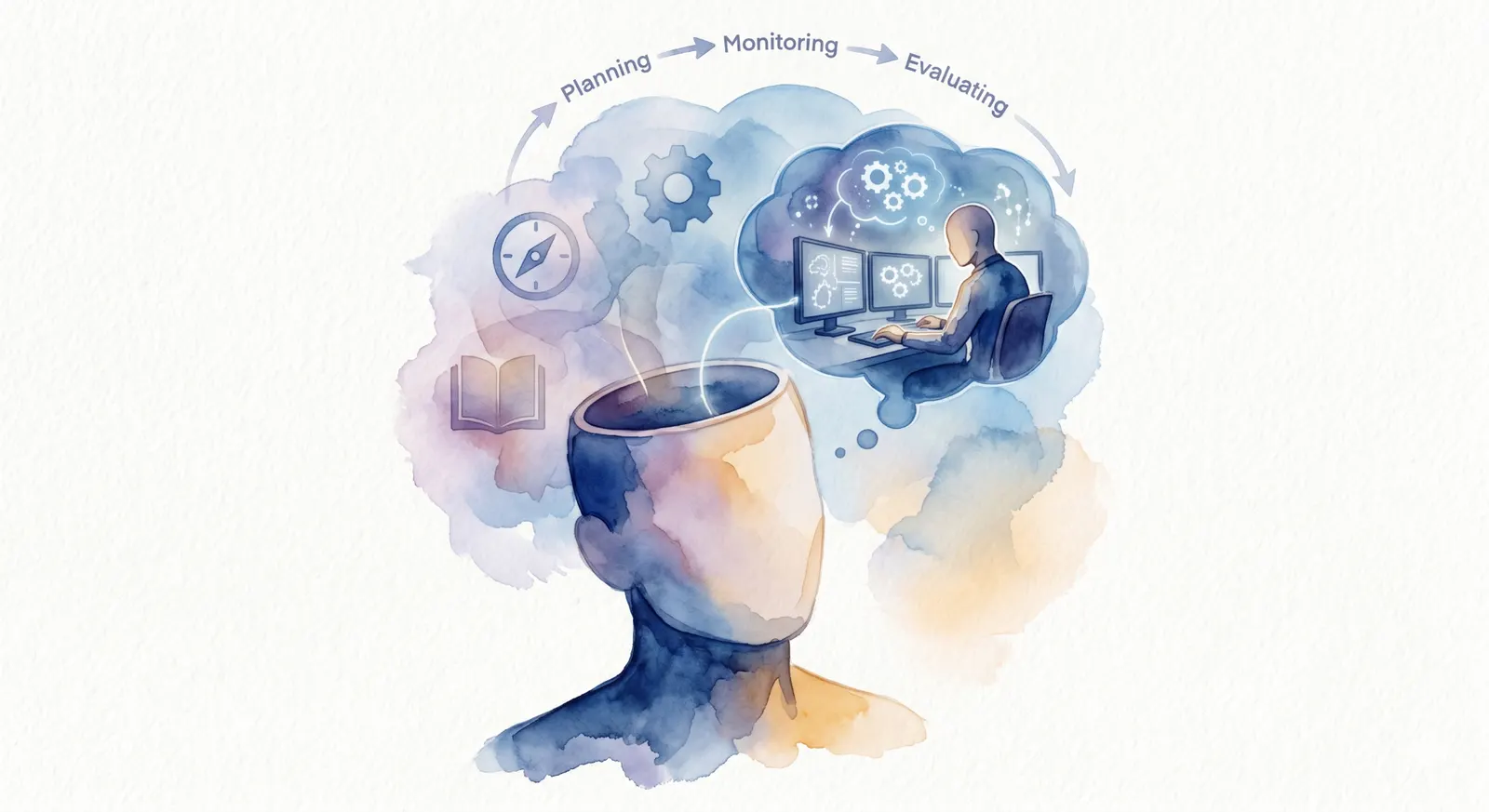
Think of your Inner Manager as having a simple three-step checklist. This loop allows you to master almost any task without necessarily working longer hours.
The Pre-Game (Planning): Before you dive into a task, the Manager asks: What is my actual goal here? Which strategy should I use? Have I handled something like this before?
The Mid-Way Check-in (Monitoring): While you're in the thick of it, the Manager taps you on the shoulder: Is this strategy working? Do I actually understand this paragraph I'm reading, or am I just looking at the words?
The Post-Game (Evaluating): Once you're done, the Manager looks back: Did I reach the goal? What could I have done better?
Real-Life: The Writer vs. The Wall
Imagine a writer trying to finish a novel for the first time. They have a great story in their head, but they have no idea how to actually build the plot.
A writer without this "Inner Manager" might just keep writing aimlessly, getting more frustrated as the story falls apart. But a writer using metacognition does something different: they take a step back. They assess the "gap" in their own knowledge. They realize, "I don't know how to structure a plot," and they stop writing to go learn that specific skill. By identifying the block early, they save themselves months of wasted effort.
This applies to everything—from a student realizing they need to review a specific math concept before they can solve a harder problem, to a professional recognizing that their current way of organizing emails is actually slowing them down.
Why You Should Care
When you start "thinking about your thinking," three things happen:
You Learn Faster: You stop wasting time on methods that don't work for your specific brain.
You Make Fewer Mistakes: Because you're monitoring yourself during the process, you catch errors before they become permanent.
You Stay Calmer: Much of our stress comes from feeling "stuck." Metacognition gives you the power to realize why you're stuck and change your approach.
The Bottom Line
Metacognition is an intellectual activity that occurs outside of our routine thoughts and natural reactions. It's about becoming a "reflective learner"—someone who knows their own strengths and weaknesses.
It is a common mechanism behind the "Theory of Mind," allowing us to model and understand how our own minds function. By understanding the true meaning of this skill, we can work smarter without necessarily having to work harder.
Next time you feel stuck, don't just push harder. Take a step back and ask: "Is my brain doing what it needs to do right now, or is it time for a new plan?"
Loading comments…